Winter Gardens

Updated: Sep 2, 2025


PERENNIALS & A NATURALISTIC GARDEN IN WINTER
I love what herbaceous perennials and their winter structure bring to the garden in the cold gloomy months. The seed heads, straw coloured grasses, stiff vertical accents and dense thickets still provide interest and are important for the birds and wild life that are present despite the cold and wet.
It is a time to appreciate the slowing down of the garden and allows you to take a break, knowing that the plants are having a rest too.
We're lucky to get frost fall on the garden which gleams in the winter sun, like crystals, creating such a glorious adornment, and for that I am grateful, as frost covered perennials are much lovelier than wet, soggy perennials.
Having said that, if my garden solely relied on herbaceous perennials for winter interest, I would be sadly missing some key attributes that make a great winter garden.

HARDY WINTER FLOWERS & OTHER SOURCES OF COLOUR
Here in the Adelaide Hills, although we do get frost, our winters are still mild enough to expect more from a winter garden. Erysimum, Rosemary, Borage and Euphorbia are flowering happily, and of course many of our natives are at their peak through winter- particularly Correas and Westringia, in my garden.
Of course, I should mention the more commonly grown plants for their winter flowers - the Camellias, Azaleas and Rhododendrons- What garden in the Adelaide Hills is complete without at least one of these.
I have a large pink flowering Camellia in my front garden that was there when we moved in- although I probably wouldn’t of planted it where it is, I have come to appreciate the delicate, feminine pink it brings to an otherwise purely green, silver and grey garden in Winter.
Hellebores of course need a mention as a very long lasting winter flower. I use these in my green and white colour scheme as many cultivars have a lovely lime green flower- I also use black flowering cultivars for a bit of drama. They're all lovely though, and well worth growing.
Along with the flowers that are bringing winter colour to the garden I heavily rely on coloured foliage, for a bit longer lasting and robust interest.
WINTER ELEGANCE
Although it’s nice to have some flowers over winter, I look forward to the winter garden as more of a quiet time – not about the riot of colour and masses of blooms you would expect at other times of the year. I enjoy the subtleness of the garden- tones of green, grey and silver- with fresh pops of lime green from Euphorbias. I do grow plants to flower through winter for the birds and insects but in the gardens closest to the house I limit the colour palette to greens and whites in winter. The pure white flowers of first Galanthus, and then Paperwhites really shine through the grey skies and pop in a subtle garden of greens and greys. This effect doesn’t work in our bright summer sunlight so I try to make the most of the simple elegance when I can.
EVERGREEN STRUCTURE
The winter garden always needs some sort of structural back up, and this is when evergreen hedges become integral. Any sort of evergreen structure is most prominent in a deciduous winter garden but a well clipped box or sphere becomes one of the most valuable stars. I particularly love our native Westringia for its subtle green grey, dense foliage. This type of structure is most important in a garden close to the house- I always try to make sure a front garden in particular has year-round structure and aesthetic appeal. Some other plants I find work really well for winter structure are Bearded Iris- for their very architectural sword shaped leaves of light blue/green, well hedged English Lavender, Wormwood- this thrives in a hot climate and doesn’t seem to be too phased by the wet and cold either- which often is not the case for these type of Mediterranean plants- so that adds a lovely softness to the garden in winter- a love the silver grey, feathery foliage. Some more Mediterranean plants that do well in the Adelaide Hills are the very sculptural Artichokes- I would grow these for their new foliage alone as their large structural silver leaves add so much. Pencil pines are great winter structure as well and look stunning with their very vertical accent.
Our native pines- Callitris are also doing well in my garden and I’m experimenting with them to see how well they clip- I love their bluey/grey foliage and fine texture.
Teucrium fruticans puffs up nicely as their drought tolerant foliage drinks up the winter rain and puts on new fresh growth- another great sphere shape to grow along side Westringia- the slightly different grey green tone adds interest.
Some other plants of note for their winter foliage are the Acanthus- these are often looking their best in winter with beautiful dark green, shiny leaves- a similar form to the artichoke but deep green and shiny- a wonderful plant- in the right spot. Along the lines of large lush green leaves I have 2 Rhubarb patches in my front garden- although I do love a Rhubarb and Apple Crumble as much as the next person I mostly grow these for their lovely large green and red leaves- They are particularly useful in part shade when many other plants seem to dislike.
Along with structural interest from plants, winter is often a time when your hard landscaping really shines. Beautiful paving materials, bricks and stone become star players along with ornamental obelisks, sculptures or teepees.
BARK
Although many of the trees I grow are deciduous, that doesn’t mean I don’t treasure them for what they can add to a winter garden- The Acer palmatums have gorgeous lime green bark and a stunning branch structure that works so well with smaller spheres surrounding them. Beautiful Birch trees and their lovely white trunks shine with the green and silver foliage surrounding them and Beech trees have gorgeous mottled white trunks. Just so beautiful. Copper Beech trees also hold onto their russet/copper coloured foliage well into early spring, creating an absolutely stunning hedge structure.
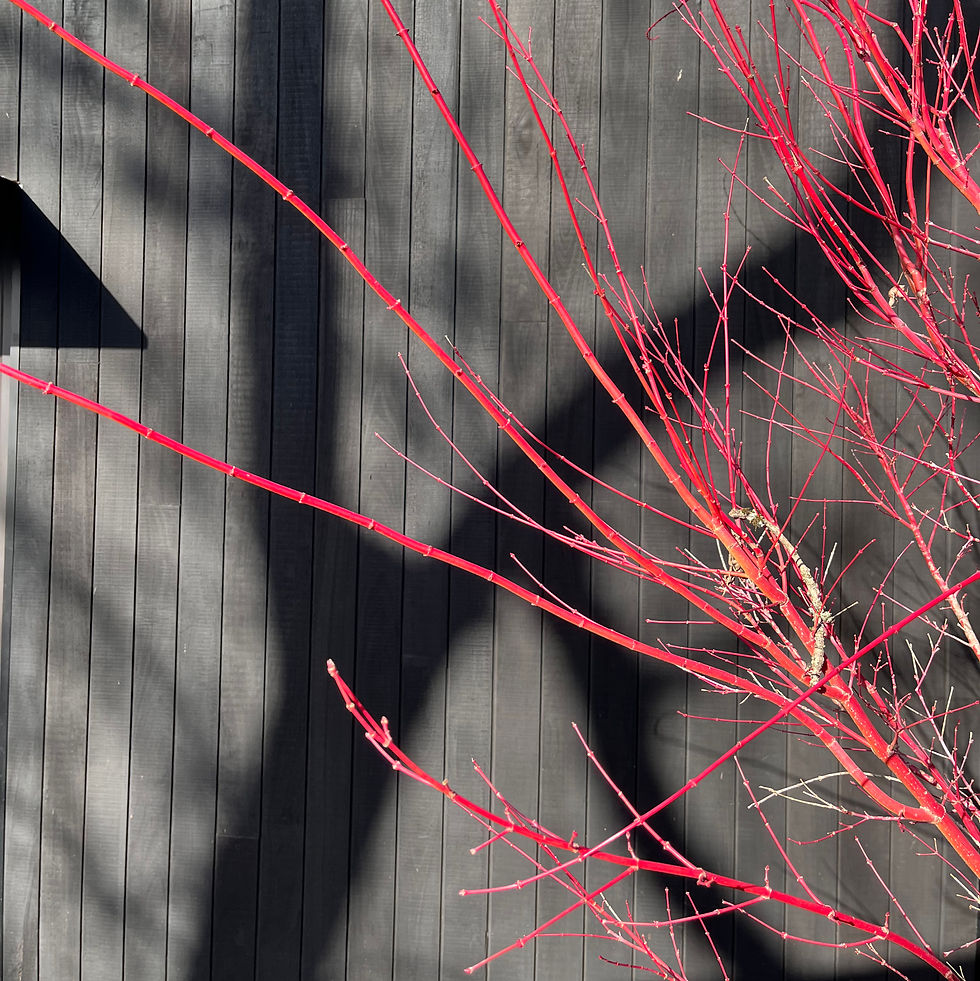
I grow the Red Stem Dogwoods for a dazzling display as the red stems really warm up a cold winter’s day. I have found the cultivar ‘Westonbirt’ to be the nicest red- but am still wanting to find ‘Mid-Winter Fire’ as this includes a bright orange in the mix. If you’re looking for a bright display like this you cannot go past Acer ‘Senkaki’- an absolutely jaw dropping bright red bark on a highly ornamental small tree. I’ve used it in a courtyard design against a "Shou Sugi Ban" black charred cladding and it looks incredible over winter.
FRAGRANCE
One aspect of the winter garden that cannot be portrayed through photographs is the fragrance of many of the winter flowering plants provide. The obvious picks are Jounquils and Tazettes, and other flowering bulbs such as Hyacinths - some of which have such a strong fragrance I can’t keep them in the house. Another plant that provides some lovely subtle fragrance is the Sarcococa confusa- I grow these on the shady South side of my house and they love it- the tiny white flowers are inconspicuous until you walk past them and notice the smell.
Winter flowering Honeysuckle is also a winter fragrance must have. Although not the most ornamental of shrubs- it makes up for the untidiness with the beautiful fragrance in winter. Hamamelis is grown for its fragrance and interesting winter flowers- however I must admit, yellow is not my favourite flower colour for winter so I opt for the burnt orange and red tones of Hamamelis ‘Jelena’ and ‘Diane’- which have incredible flowers in their own right- however the fragrance is lacking.
Chimananthos is another interesting winter flowering shrub with deliciously scented flowers, and Osmanthus is also a must have on my list- this also grows well in part shade so is a winning plant for me. Of course Daphne is a beautiful evergreen shrub with the nicest fragrance – also a must have if you have the right spot for it.
LATE WINTER
I usually see winter broken up into two separate time frames. There is pre Solstice Winter and Post Solstice Winter- the first is when the garden is at it's most quiet, the days are short and the plants are retreating back into the ground. This is when the herbaceous perennials are at their most sculptural- before the winter rains have really smashed them and they aren't too soggy. The only bulbs around are the Galanthus and many of the Hellebores haven't started flowering.
After the Solstice you can see the garden start to wake up, the grass starts to grow again, some seeds start to germinate in the garden- Nigella, Cornflowers, Poppies, Ammi majus, Wild Carrot, Cephalaria, Orlaya, Forget-me-not, Cerinthe, Coriander and Sweet Peas are all starting to come up and the herbaceous perennials are starting to put on some fresh new basal growth.
This is the time to start cutting them back and the garden really does feel refreshed!
The late winter bulbs are also now starting to flower- the Paperwhites, Tazettes and Jonquils the first to bloom, followed later by the Daffodils, Hyacinths and Grape Hyacinths. Cyclamen are also looking very colourful in late winter along with Bergenia and Anemone coronaria. Little jewels on a grey day.
The trees with the earliest blossom begin to flower- Ornamental and wild Pears, then Almonds followed by Plums are all flowering late winter and the bees are certainly relieved.
Although considered weeds I can't help to admire the Pussy Willow blooms that flower around the same time as the Pears- the bees also cover them on a sunny day! Native bees just as much as the Honey bees. A sign that Spring is well and truly just around the corner!

Ornamental Pear blossom


Comments